University of Science and Culture Faculty Member Publishes Research in the International Journal Textile
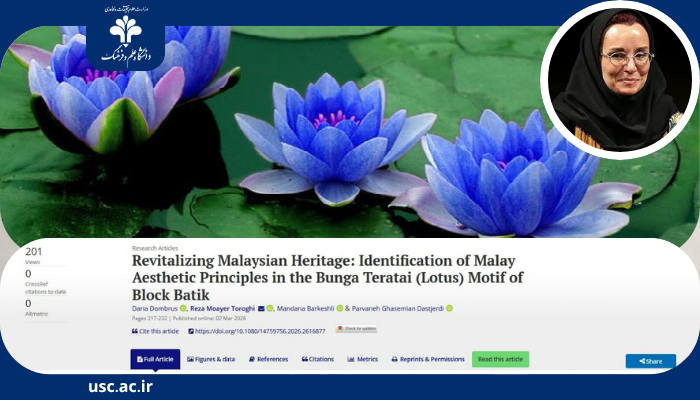
A research article by Dr. Parvaneh Ghasemian Dastjerdi, faculty member of the Faculty of Art and Architecture at the University of Science and Culture, has been published in the international journal Textile: The Journal of Cloth and Culture, published by Taylor & Francis. The journal is indexed in both Web of Science (WoS) and Scopus, with an Impact Factor of 0.3, a CiteScore of 0.6, and is ranked in the Q2 quartile.
According to the Public Relations Office of the University of Science and Culture, the article, entitled “Exploring beyond the surface: Geofenced storytelling in Isfahan’s tourism experience,” examines the role and significance of the Bunga Teratai (lotus/water lily) motif in Malaysian block batik and its relationship to the principles of Malay aesthetics based on the theoretical framework developed by Zakaria Ali.
Despite the cultural significance of batik in Malaysia, relatively little research has been conducted on traditional floral motifs within the context of Malay aesthetic principles. The study employs thematic analysis of interviews with batik artists, together with a visual analysis of two historic batik artworks—Lotuses (1970s) and Lotus Pods (1960s). The findings reveal that the lotus motif represents artistic elegance, intricate craftsmanship, and the continuity of Malay cultural heritage. Symbolically, the lotus embodies life, spiritual purity, and the connection between pre-Islamic and Islamic traditions.
The participating artists also emphasized that the lotus motif has remained an enduring element of Malaysian batik due to its extensive use in ceremonial and traditional garments. However, the study identifies several challenges to preserving this cultural heritage, including dependence on imported raw materials and the declining transmission of traditional knowledge across generations.
The researchers recommend implementing educational programs to teach traditional batik techniques to emerging artists and incorporating the principles of Malay aesthetics into national cultural policies. Overall, the study highlights the importance of preserving the lotus motif as an integral component of Malaysian batik identity and seeks to reinforce its significance within contemporary Malaysian art and culture.
This research is the outcome of an international collaborative agreement between UCSI University, Malaysia, and the University of Science and Culture, reflecting the growing international research partnerships of the University and its commitment to advancing interdisciplinary scholarship in art, culture, and heritage studies.
For access to the full article, please visit the publisher’s website.